Read story

Why Navigation is a Diver's Most Critical Skill

Underwater navigation techniques are essential skills that separate confident divers from those who waste air and energy searching for their boat or entry point. These techniques combine compass use, natural environmental cues, and distance estimation to help you explore safely and return to your starting point.

Core underwater navigation methods include:

  1. Compass navigation - Setting and following precise headings.
  2. Natural navigation - Using sunlight, depth changes, and landmarks.
  3. Distance estimation - Tracking progress through kick cycles, time, or air consumption.
  4. Search patterns - Systematic approaches like U-turns and square patterns.
  5. Environmental awareness - Reading currents, sand ripples, and reef formations.

Imagine the sinking feeling of being lost underwater—wondering how far you'll have to swim and in which direction. This is exactly what proper navigation prevents. Good navigation saves energy, reduces air consumption, keeps you with your buddy, and maximizes your exploration time. Poor navigation leads to long surface swims, wasted gas, buddy separation, and increased risk.

The underwater environment strips away your land-based sense of direction. Without visual references or GPS, divers must rely on learned skills combining natural observation with basic instrumentation. Whether you're diving from shore or boat, navigation determines whether you spend your dive enjoying the underwater world or anxiously searching for your exit. Mastering these techniques isn't just about enjoyment—it's about reducing the physiological stress that disorientation places on divers, which in turn lowers cognitive load and air consumption.
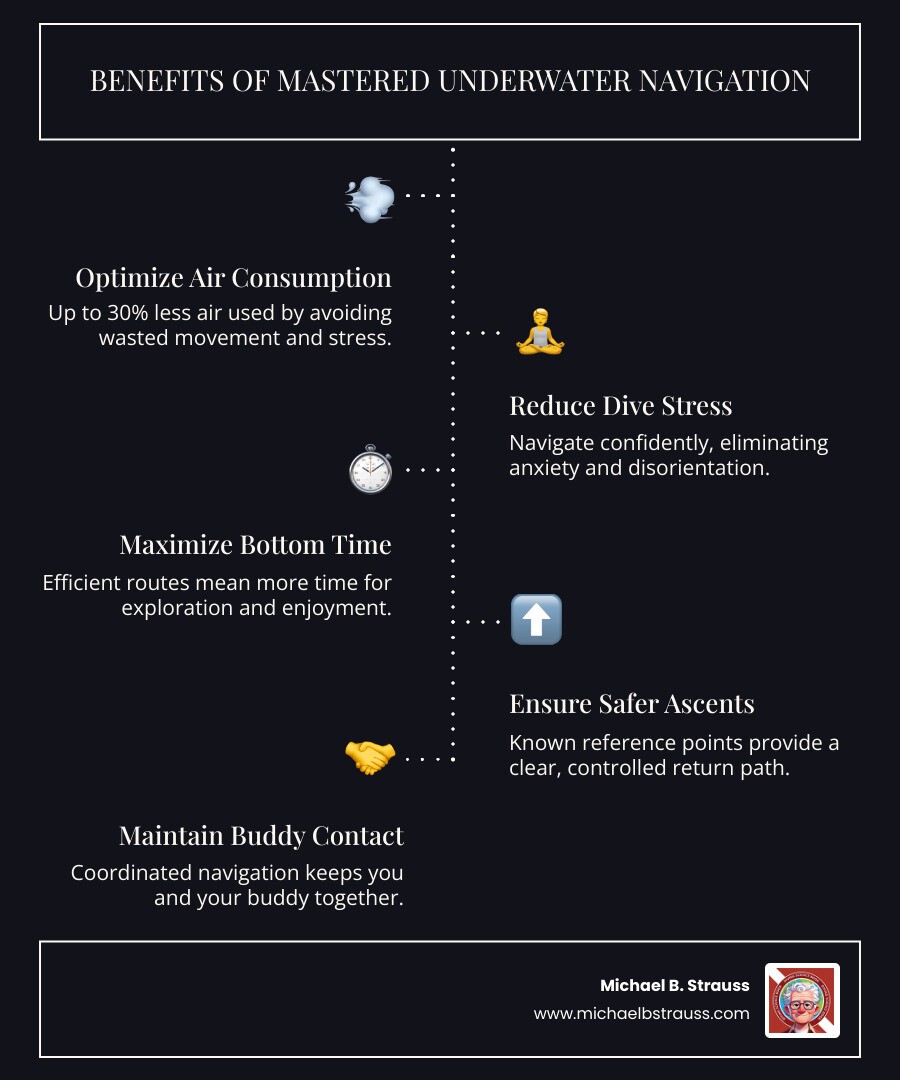
infographic showing benefits of good underwater navigation including 30% less air consumption, reduced stress levels, more bottom time for exploration, safer ascents with known reference points, and staying with dive buddy - Underwater navigation techniques infographic infographic-line-5-steps-dark

Glossary for Underwater navigation techniques:

The Foundations of Underwater Navigation Techniques

Effective underwater navigation techniques are built on a foundation of planning, observation, and practiced skill.

Pre-Dive Planning and Surface Observation

Successful navigation begins before you enter the water. This crucial planning phase establishes your bearings and helps you anticipate challenges.
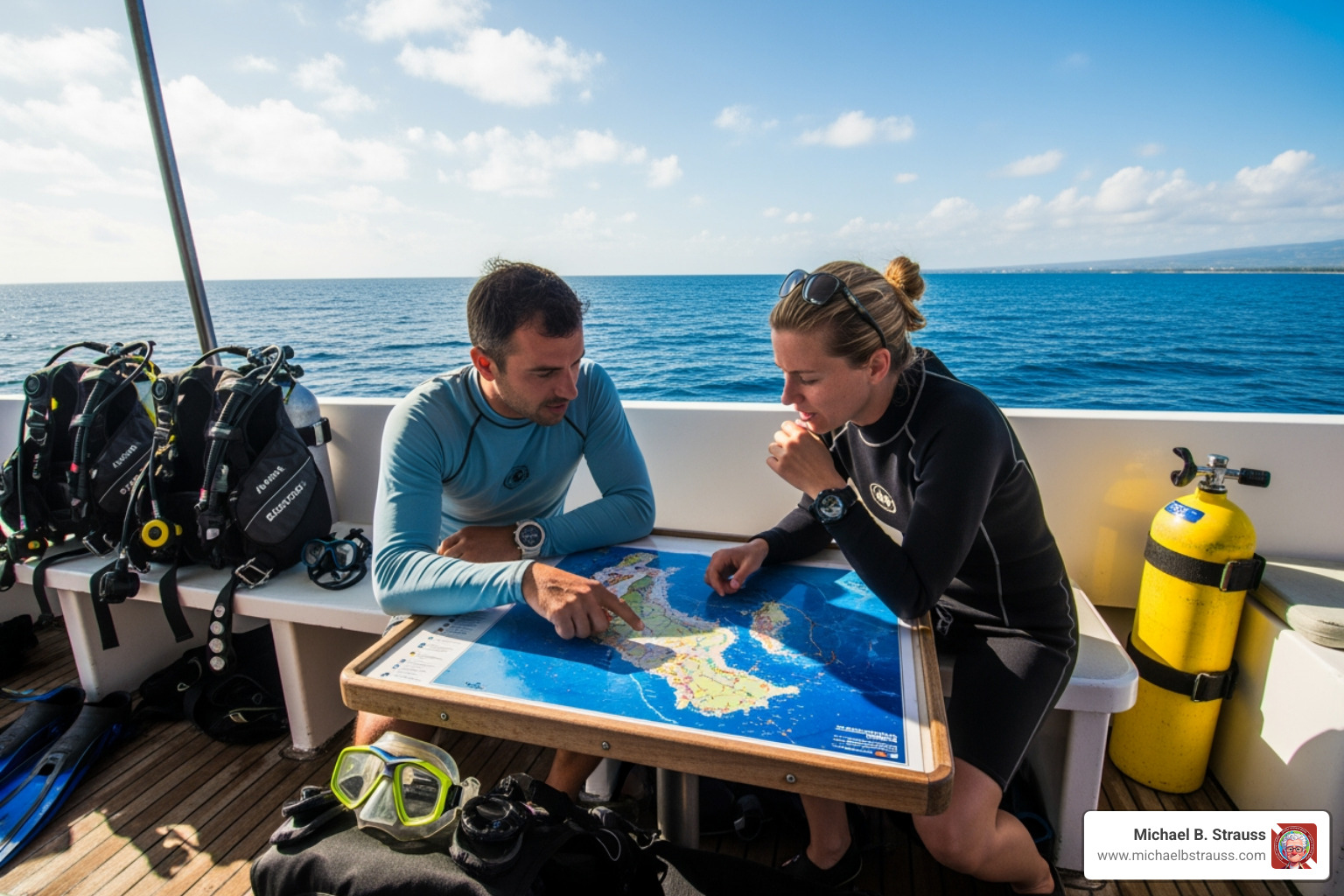
divers planning a dive on a boat with a map - Underwater navigation techniques

First, gather information about the dive site by consulting maps, local experts, or your divemaster. Understand the site's layout, key features, depths, and potential currents. Next, create a detailed dive plan with your buddy, including your intended route, turnaround pressure, and entry/exit points. Note the boat's orientation or identify prominent shore references.

Before descending, observe the sun's position and any visible currents. Plan to swim against the current at the start of the dive so it can assist your return. Designate a primary navigator and a monitor to track time and depth. This shared responsibility ensures both divers are aware of the plan. Finally, as you descend, look back at your entry point to memorize its appearance from below.

Key Natural Navigation Cues

Natural navigation involves interpreting your surroundings to use as a guide. Developing a keen sense of observation allows you to use the environment's subtle clues.

  1. Landmarks and Reef Formations: Use distinct features like coral heads, rock formations, sand channels, or wrecks as waypoints. As you pass a landmark, turn around to see how it will look on your return trip.
  2. Depth Contours: The seafloor's slope is a powerful tool. Following a specific depth contour on a reef or wall keeps you on a consistent path. Generally, swimming uphill leads to shallower water (and shore), while downhill leads deeper.
  3. Sand Ripples and Bottom Composition: Sand ripples formed by wave action often run parallel to the shore. Changes in the bottom, such as from sand to rubble, can also signal your location.
  4. Light Direction: The sun's angle provides a general sense of direction. Note its position when you descend and use the opposite position for your return. This is less reliable at midday or in poor visibility.
  5. Water Movement: Currents and surge provide valuable information. A surge often moves perpendicular to the shore, indicating its direction. Plan to swim against the current on your way out and use it to assist your return.
  6. Marine Life: The behavior of marine life can offer clues. Schools of fish may congregate near specific structures, and the sounds of a reef can help you locate it in low visibility.

Mastering the Compass and Other Essential Tools

When natural cues are limited, the dive compass is your most reliable instrument for precise direction-finding.
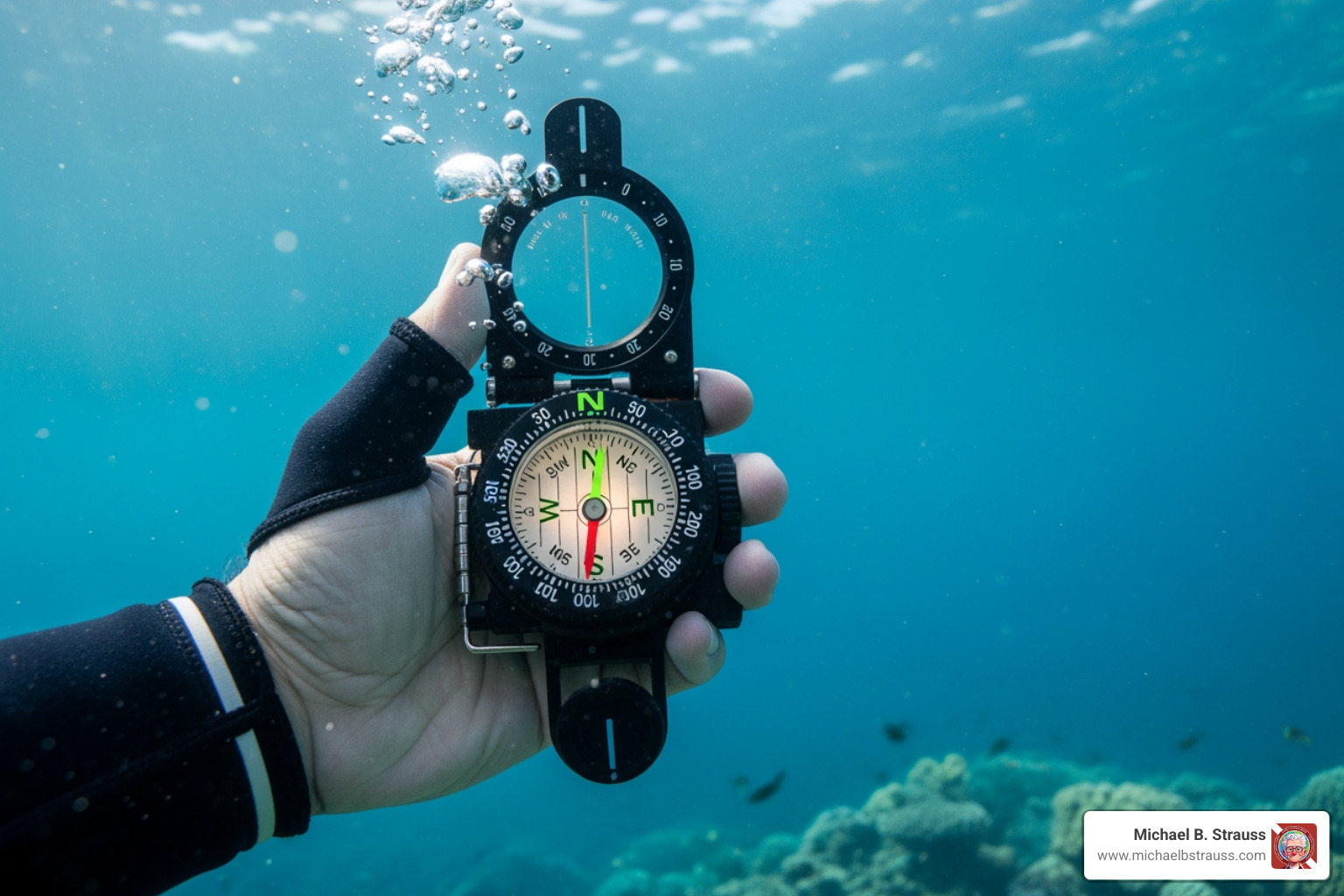
close-up on a dive compass being held correctly - Underwater navigation techniques

Using the Dive Compass:Hold the compass level and steady. To set a heading, align the lubber line (which points in your direction of travel) with your target. Then, rotate the bezel until the index marks bracket the north arrow. As you swim, keep the north arrow between the index marks. Avoid fixating on the compass; instead, use it to pick a visual reference in the distance, swim to it, and repeat. For your return, simply set a reciprocal course by rotating your bezel 180 degrees.

Be aware that large metal objects like wrecks or even your own steel tank can cause magnetic interference. Take headings away from these materials.

Essential Navigation Equipment:

  • Dive Compass (wrist-mounted, console, or integrated into a dive computer)
  • Underwater Navigation Slate (for noting headings and drawing maps)
  • Dive Reel/Spool and Line Markers (for overhead environments)
  • Dive Light
  • Surface Marker Buoy (SMB)

Estimating Distance and Measuring Progress

Knowing your direction is only half the battle; you also need to track your distance. Estimating distance ensures you don't overshoot your target or run low on air.

  1. Kick Cycles: This is a common method. First, establish a personal baseline by counting your fin kicks over a known distance (e.g., 20 meters/65 feet). You can then use this count to estimate distance during a dive. This method is most accurate in calm conditions.
  2. Time Measurement: If you know your average swimming speed, you can estimate distance based on time. This is often used with a compass to swim a specific heading for a set duration before turning.
  3. Air Consumption: Monitoring your gas supply is a crucial way to manage distance. The "rule of thirds" is a standard gas planning strategy: use one-third of your air for the outbound journey, one-third for the return, and keep one-third in reserve. Your turnaround point is determined by your tank pressure, which acts as an automatic distance control.

Advanced Applications and Lifelong Skill Development

Mastering foundational underwater navigation techniques opens the door to more complex dive environments where advanced skills are critical for safety.

  1. Low Visibility: When visibility is poor, natural cues disappear, and your reliance on the compass becomes absolute. Trust your instruments, maintain steady buoyancy, and move slowly to avoid disorientation. Your land-based sense of direction can be misleading; focus on your training.
  2. Overhead Environments (Caves, Wrecks): These environments prevent a direct ascent and require specialized training. The primary navigation tool is a continuous guideline laid from a reel, providing a physical path to the exit. Wrecks can also cause compass interference, making the guideline even more critical. Always be mindful of the potential for silt-outs, which can instantly reduce visibility to zero.
  3. Currents and Drift Diving: To counteract a cross-current, adjust your heading slightly "up-current" to maintain your intended path. In a drift dive, you use the current to travel. Pre-dive planning is essential to know the current's direction and speed. You'll deploy a Surface Marker Buoy (SMB) upon surfacing to signal your position to the boat.

Search Patterns and Continuous Practice

Navigation skills also include systematic methods for searching an area for a lost item or a specific feature. These patterns require diligent compass work and distance estimation.

Common Search Patterns:

  1. U-Pattern: Ideal for small areas. Swim a straight line, make a 90-degree turn, swim a short distance, make another 90-degree turn, and swim back parallel to your original path.
  2. Expanding Square Pattern: Best for larger areas. From a central point, swim a set distance, turn 90 degrees, and repeat. With each full square, increase the length of the sides to expand your search area.
  3. Circular Search: From a fixed point, a diver swims in a circle on a line of a set length. The line's length is increased after each full circle.

The Importance of Practice:Like any skill, underwater navigation techniques improve with practice. Many training agencies teach these skills in advanced courses, which often include navigation as a mandatory skill. Specialty courses offer more in-depth training for those looking to become experts.

Regular practice builds confidence, saves energy, and reduces air consumption. Combining these skills with a solid understanding of Diving Science principles will make you a more capable and safer diver. Dr. Michael B. Strauss, a renowned expert in diving safety, offers invaluable insights in his comprehensive diving books, which are essential reads for reinforcing the link between skill mastery and diver well-being.

To deepen your understanding, get your copy of "Diving Science: Revisited" here: https://www.bestpub.com/view-all-products/product/diving-science-revisited/category_pathway-48.html

DISCLAIMER: Articles are for "EDUCATIONAL PURPOSES ONLY", not to be considered advice or recommendations.

Download Full PDF
Tags:

Why Navigation is a Diver's Most Critical Skill

Underwater navigation techniques are essential skills that separate confident divers from those who waste air and energy searching for their boat or entry point. These techniques combine compass use, natural environmental cues, and distance estimation to help you explore safely and return to your starting point.

Core underwater navigation methods include:

  1. Compass navigation - Setting and following precise headings.
  2. Natural navigation - Using sunlight, depth changes, and landmarks.
  3. Distance estimation - Tracking progress through kick cycles, time, or air consumption.
  4. Search patterns - Systematic approaches like U-turns and square patterns.
  5. Environmental awareness - Reading currents, sand ripples, and reef formations.

Imagine the sinking feeling of being lost underwater—wondering how far you'll have to swim and in which direction. This is exactly what proper navigation prevents. Good navigation saves energy, reduces air consumption, keeps you with your buddy, and maximizes your exploration time. Poor navigation leads to long surface swims, wasted gas, buddy separation, and increased risk.

The underwater environment strips away your land-based sense of direction. Without visual references or GPS, divers must rely on learned skills combining natural observation with basic instrumentation. Whether you're diving from shore or boat, navigation determines whether you spend your dive enjoying the underwater world or anxiously searching for your exit. Mastering these techniques isn't just about enjoyment—it's about reducing the physiological stress that disorientation places on divers, which in turn lowers cognitive load and air consumption.

infographic showing benefits of good underwater navigation including 30% less air consumption, reduced stress levels, more bottom time for exploration, safer ascents with known reference points, and staying with dive buddy - Underwater navigation techniques infographic infographic-line-5-steps-dark

Glossary for Underwater navigation techniques:

The Foundations of Underwater Navigation Techniques

Effective underwater navigation techniques are built on a foundation of planning, observation, and practiced skill.

Pre-Dive Planning and Surface Observation

Successful navigation begins before you enter the water. This crucial planning phase establishes your bearings and helps you anticipate challenges.

divers planning a dive on a boat with a map - Underwater navigation techniques

First, gather information about the dive site by consulting maps, local experts, or your divemaster. Understand the site's layout, key features, depths, and potential currents. Next, create a detailed dive plan with your buddy, including your intended route, turnaround pressure, and entry/exit points. Note the boat's orientation or identify prominent shore references.

Before descending, observe the sun's position and any visible currents. Plan to swim against the current at the start of the dive so it can assist your return. Designate a primary navigator and a monitor to track time and depth. This shared responsibility ensures both divers are aware of the plan. Finally, as you descend, look back at your entry point to memorize its appearance from below.

Key Natural Navigation Cues

Natural navigation involves interpreting your surroundings to use as a guide. Developing a keen sense of observation allows you to use the environment's subtle clues.

  1. Landmarks and Reef Formations: Use distinct features like coral heads, rock formations, sand channels, or wrecks as waypoints. As you pass a landmark, turn around to see how it will look on your return trip.
  2. Depth Contours: The seafloor's slope is a powerful tool. Following a specific depth contour on a reef or wall keeps you on a consistent path. Generally, swimming uphill leads to shallower water (and shore), while downhill leads deeper.
  3. Sand Ripples and Bottom Composition: Sand ripples formed by wave action often run parallel to the shore. Changes in the bottom, such as from sand to rubble, can also signal your location.
  4. Light Direction: The sun's angle provides a general sense of direction. Note its position when you descend and use the opposite position for your return. This is less reliable at midday or in poor visibility.
  5. Water Movement: Currents and surge provide valuable information. A surge often moves perpendicular to the shore, indicating its direction. Plan to swim against the current on your way out and use it to assist your return.
  6. Marine Life: The behavior of marine life can offer clues. Schools of fish may congregate near specific structures, and the sounds of a reef can help you locate it in low visibility.

Mastering the Compass and Other Essential Tools

When natural cues are limited, the dive compass is your most reliable instrument for precise direction-finding.

close-up on a dive compass being held correctly - Underwater navigation techniques

Using the Dive Compass:Hold the compass level and steady. To set a heading, align the lubber line (which points in your direction of travel) with your target. Then, rotate the bezel until the index marks bracket the north arrow. As you swim, keep the north arrow between the index marks. Avoid fixating on the compass; instead, use it to pick a visual reference in the distance, swim to it, and repeat. For your return, simply set a reciprocal course by rotating your bezel 180 degrees.

Be aware that large metal objects like wrecks or even your own steel tank can cause magnetic interference. Take headings away from these materials.

Essential Navigation Equipment:

  • Dive Compass (wrist-mounted, console, or integrated into a dive computer)
  • Underwater Navigation Slate (for noting headings and drawing maps)
  • Dive Reel/Spool and Line Markers (for overhead environments)
  • Dive Light
  • Surface Marker Buoy (SMB)

Estimating Distance and Measuring Progress

Knowing your direction is only half the battle; you also need to track your distance. Estimating distance ensures you don't overshoot your target or run low on air.

  1. Kick Cycles: This is a common method. First, establish a personal baseline by counting your fin kicks over a known distance (e.g., 20 meters/65 feet). You can then use this count to estimate distance during a dive. This method is most accurate in calm conditions.
  2. Time Measurement: If you know your average swimming speed, you can estimate distance based on time. This is often used with a compass to swim a specific heading for a set duration before turning.
  3. Air Consumption: Monitoring your gas supply is a crucial way to manage distance. The "rule of thirds" is a standard gas planning strategy: use one-third of your air for the outbound journey, one-third for the return, and keep one-third in reserve. Your turnaround point is determined by your tank pressure, which acts as an automatic distance control.

Advanced Applications and Lifelong Skill Development

Mastering foundational underwater navigation techniques opens the door to more complex dive environments where advanced skills are critical for safety.

  1. Low Visibility: When visibility is poor, natural cues disappear, and your reliance on the compass becomes absolute. Trust your instruments, maintain steady buoyancy, and move slowly to avoid disorientation. Your land-based sense of direction can be misleading; focus on your training.
  2. Overhead Environments (Caves, Wrecks): These environments prevent a direct ascent and require specialized training. The primary navigation tool is a continuous guideline laid from a reel, providing a physical path to the exit. Wrecks can also cause compass interference, making the guideline even more critical. Always be mindful of the potential for silt-outs, which can instantly reduce visibility to zero.
  3. Currents and Drift Diving: To counteract a cross-current, adjust your heading slightly "up-current" to maintain your intended path. In a drift dive, you use the current to travel. Pre-dive planning is essential to know the current's direction and speed. You'll deploy a Surface Marker Buoy (SMB) upon surfacing to signal your position to the boat.

Search Patterns and Continuous Practice

Navigation skills also include systematic methods for searching an area for a lost item or a specific feature. These patterns require diligent compass work and distance estimation.

Common Search Patterns:

  1. U-Pattern: Ideal for small areas. Swim a straight line, make a 90-degree turn, swim a short distance, make another 90-degree turn, and swim back parallel to your original path.
  2. Expanding Square Pattern: Best for larger areas. From a central point, swim a set distance, turn 90 degrees, and repeat. With each full square, increase the length of the sides to expand your search area.
  3. Circular Search: From a fixed point, a diver swims in a circle on a line of a set length. The line's length is increased after each full circle.

The Importance of Practice:Like any skill, underwater navigation techniques improve with practice. Many training agencies teach these skills in advanced courses, which often include navigation as a mandatory skill. Specialty courses offer more in-depth training for those looking to become experts.

Regular practice builds confidence, saves energy, and reduces air consumption. Combining these skills with a solid understanding of Diving Science principles will make you a more capable and safer diver. Dr. Michael B. Strauss, a renowned expert in diving safety, offers invaluable insights in his comprehensive diving books, which are essential reads for reinforcing the link between skill mastery and diver well-being.

To deepen your understanding, get your copy of "Diving Science: Revisited" here: https://www.bestpub.com/view-all-products/product/diving-science-revisited/category_pathway-48.html

DISCLAIMER: Articles are for "EDUCATIONAL PURPOSES ONLY", not to be considered advice or recommendations.