Getting Started: An Introduction to Scuba Equipment
Scuba diving gear is the essential equipment that keeps you safe and comfortable underwater. Whether you're a beginner or a seasoned diver, the right equipment is the difference between an unforgettable adventure and an uncomfortable experience.
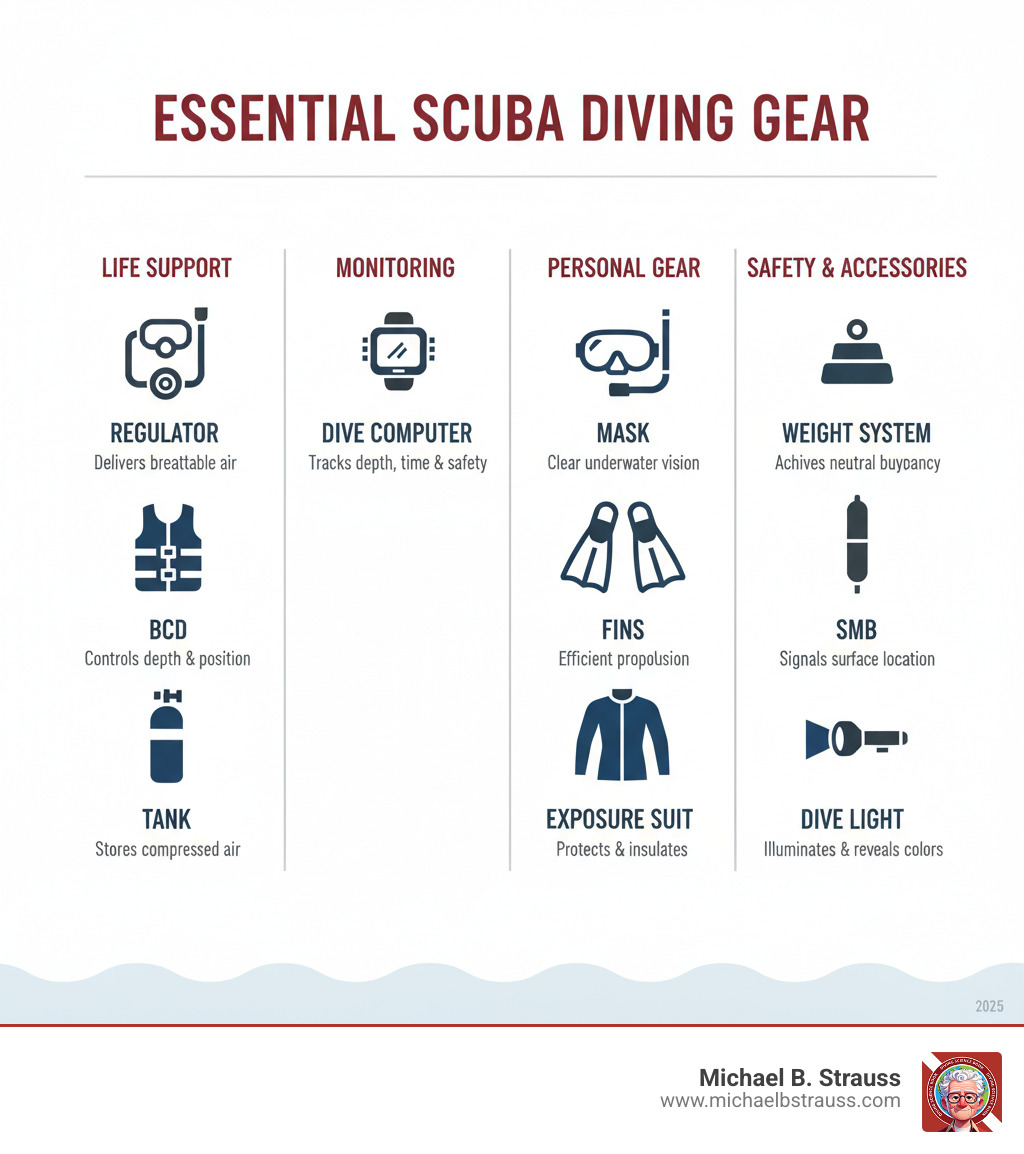
The 10 Essential Pieces of Scuba Diving Gear:
- Regulator - Delivers breathable air from your tank
- Buoyancy Control Device (BCD) - Controls your depth and position
- Dive Computer - Tracks depth, time, and safety limits
- Mask - Provides clear underwater vision
- Fins - Enables efficient underwater propulsion
- Exposure Suit - Protects against temperature and elements
- Tank - Stores compressed breathing air
- Weight System - Helps achieve neutral buoyancy
- Surface Marker Buoy (SMB) - Signals your location to boats
- Dive Light - Illuminates dark environments and reveals true colors
The global scuba diving equipment market is projected to reach USD 7.2 billion by 2030, reflecting growing interest and rapid innovation in gear technology that makes diving safer and more accessible.
As one experienced diver noted, it's tempting to buy a lot of gear to look experienced. However, quality matters more than quantity. Understanding each piece's function is the first step toward making smart choices.
For professionals who balance demanding careers with adventure, reliable equipment is crucial. The right gear is fundamental to dive safety and confidence. Thanks to over 80 years of innovation since Jacques Cousteau's first "aquatic lung" in 1943, today's divers benefit from decades of engineering refinement.
Explore more about scuba diving gear:
Your Essential Scuba Diving Gear Breakdown
Taking the plunge requires the right scuba diving gear to keep you safe and comfortable. Think of your equipment as a system where each piece plays a vital role. Let's explore the essential components.
The Core Life Support System: Regulators & BCDs
Your regulator and Buoyancy Control Device (BCD) are the heart of your scuba diving gear—investments in your safety and diving future.
The regulator is an engineering marvel that transforms high-pressure air from your tank into breathable air. The first stage attaches to the tank, reducing pressure significantly. Piston regulators are simple and reliable, especially in cold water, while diaphragm regulators seal internal parts from the environment, resisting corrosion. The second stage is the mouthpiece, delivering air at the surrounding water pressure for natural breathing. Many have adjustable breathing resistance for comfort.
Your Buoyancy Control Device (BCD) is your underwater elevator, allowing you to ascend, descend, or hover effortlessly. Mastering neutral buoyancy is a key skill that protects marine life. Jacket-style BCDs are popular with beginners, offering great surface stability and often including integrated weight pockets. Back-inflate BCDs are preferred by experienced divers for better horizontal swimming trim. Backplate and wing systems offer maximum customization for technical divers. When choosing, prioritize comfort, fit, and lift capacity.
| Feature | Jacket-Style BCDs | Back-Inflate BCDs |
|---|---|---|
| Buoyancy | Distributed around the torso | Concentrated on the diver's back |
| Underwater Trim | Can sometimes lead to a slightly upright position | Excellent horizontal trim, promoting efficient swimming |
| Surface Position | Very stable and comfortable on the surface | May push the diver slightly forward on the surface |
| Comfort | Often padded, feels like a vest, good for beginners | Less restrictive around the chest, good for streamlining |
| Weight System | Commonly feature integrated weight pockets | Often use integrated weight pockets or separate weight belts |
| Suitability | Ideal for recreational divers and beginners | Preferred by experienced and technical divers |
Visibility and Propulsion: Choosing Masks & Fins
Your mask and fins are the scuba diving gear that connect you to the underwater environment.
Your dive mask is your window to the underwater world. A proper fit is essential to prevent leaks. Test this by placing the mask on your face without the strap and inhaling gently through your nose; it should stay suctioned. Single-lens masks offer a wide view, while double-lens masks can accommodate prescription lenses. Low-volume masks are easier to clear. Always choose tempered glass for safety.
Your fins provide efficient propulsion. Open-heel fins require dive booties and are versatile for various conditions. Full-foot fins are great for warm water and offer a direct feel. Paddle fins are the powerful workhorses, while Split fins are designed to reduce drag and effort. The right choice depends on your diving style and environment.
Monitoring Your Dive: The Modern Dive Computer
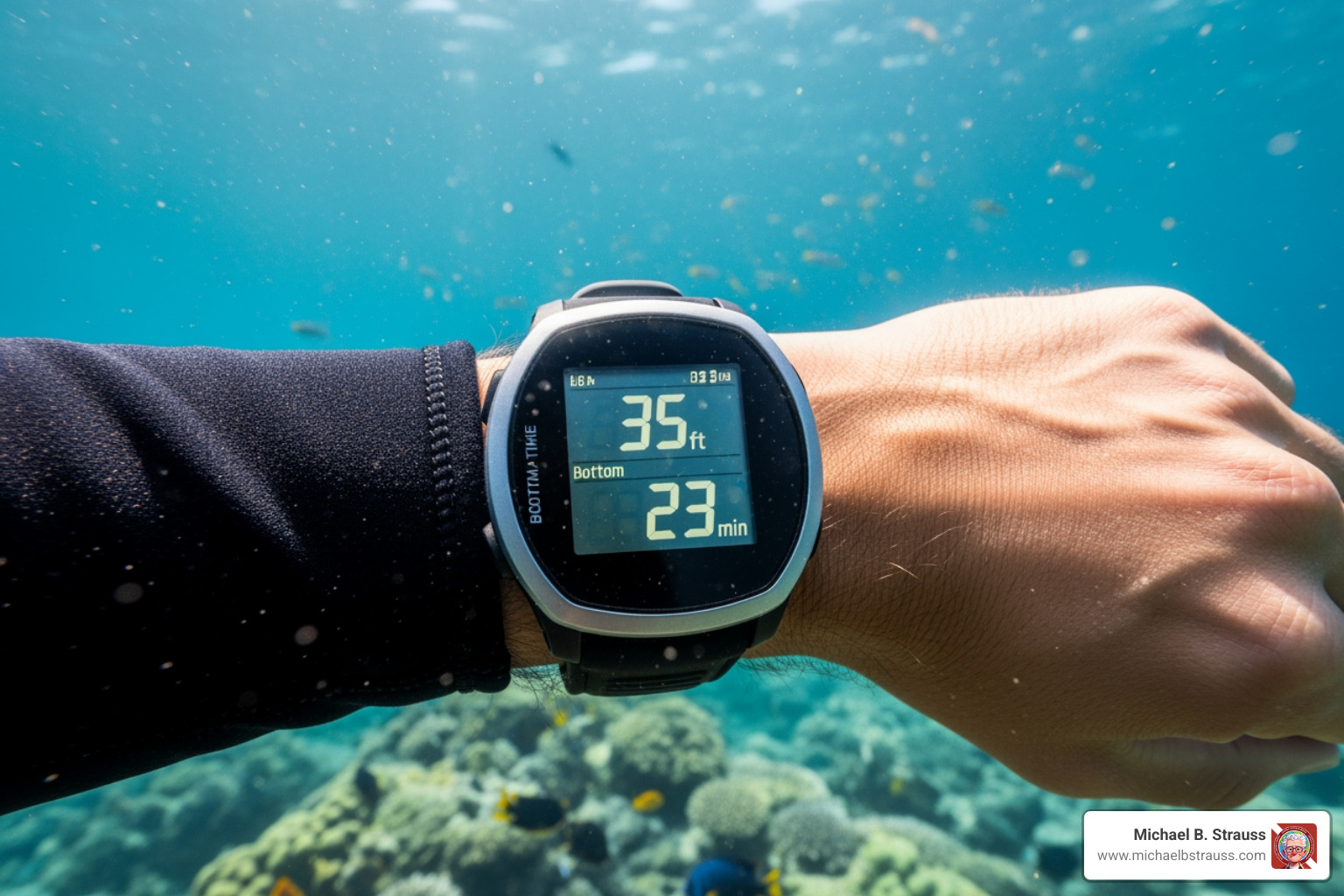
Modern dive computers are essential scuba diving gear, replacing analog gauges and dive tables for improved safety. They continuously monitor your depth and time, calculating your no-decompression limits—the time you can stay at a certain depth without needing decompression stops.
A critical feature is ascent rate monitoring, which alerts you if you're ascending too quickly, a major cause of decompression sickness. Computers also prompt safety stops (typically three minutes at 15-20 feet) for an added safety margin. When choosing a computer, prioritize a readable display and clear alarms. For beginners, a user-friendly model that provides essential data without being overwhelming is a trusted option.
Specialized Equipment and Accessories for your scuba diving gear
Specialized scuba diving gear adapts your kit to different environments.
Exposure suits protect you from cold, scrapes, and stings. Wetsuits trap a layer of water that your body heats for insulation. A 3mm wetsuit is for tropical water, a 5mm wetsuit is a versatile all-rounder, and a 7mm wetsuit is for cold water. Drysuits keep you completely dry and are for the coldest conditions, but require special training.
Essential accessories complete your kit. A dive light is crucial for night dives and reveals true colors during the day. A dive knife or cutting tool is a safety device for mess in fishing lines. A surface marker buoy (SMB) signals your location to boats. A snorkel is useful for surface swims and adds a layer of safety.
Finalizing Your Kit: Innovations and Expert Advice
As you build your collection of scuba diving gear, you're investing in a legacy of innovation. Understanding this technology helps you make smarter choices.
The Evolution and Future of Scuba Diving Gear
Every breath underwater is thanks to the 1943 invention of the "aquatic lung" by Jacques-Yves Cousteau and Émile Gagnan. This regulator revolutionized exploration and paved the way for modern scuba companies. Since then, scuba diving gear has evolved dramatically. Analog gauges have been replaced by sophisticated dive computers, and material science has given us lighter, stronger, and more corrosion-resistant equipment. The future promises even greater technological integration, customization, and a focus on sustainability. For a deeper look into the science, explore Diving Science.
Making the Right Choice: Fit, Color, and Further Learning
When selecting your scuba diving gear, details matter. Proper fit isn't negotiable—it's the foundation of comfort and safety. A leaking mask, ill-fitting fins, or a loose wetsuit can ruin a dive. Always test gear for fit before buying.
Color might seem purely aesthetic, but it serves a practical purpose. Brightly colored fins, snorkels, or BCD accents increase your visibility to your buddy and to boats on the surface.
For those just starting, the rent versus buy decision deserves consideration. We recommend renting complex items like BCDs and regulators for your first few dives to experience different models. While owning your gear builds confidence and saves on rental fees long-term, remember it adds to your travel luggage.
The best scuba diving gear is ultimately the gear that fits you well, functions reliably, and gives you confidence. This is an investment in your safety and enjoyment. To deepen your understanding of dive safety and best practices, the comprehensive guides by Dr. Michael B. Strauss offer invaluable insights for divers at every level.
Ready to take your knowledge to the next level? Get your copy of 'Diving Science Revisited' today!
DISCLAIMER: Articles are for "EDUCATIONAL PURPOSES ONLY", not to be considered advice or recommendations.


