Your Essential Guide to Becoming a Diver Medic Technician
A diving medical technician course trains you to become the critical first medical responder in diving emergencies. You'll learn to manage life-threatening conditions like decompression sickness and barotrauma in remote environments where advanced medical help may be hours or days away.
Quick Overview of DMT Courses:
- Duration: 48-60 hours (5-10 days), often with online modules plus hands-on training.
- Prerequisites: EMT certification or commercial diver qualification, plus medical clearance for pressurized environments.
- Core Skills: Advanced airway management, IV therapy, chest decompression, hyperbaric chamber operations, neurological assessments.
- Certification Bodies: NBDHMT (National Board of Diving & Hyperbaric Medical Technology), IMCA (International Marine Contractors Association), DCBC (Diver Certification Board of Canada).
- Validity: 2 years, with recertification requiring continuing education and clinical hours.
- Career Settings: Offshore drilling rigs, commercial dive operations, scientific research vessels, hyperbaric treatment facilities.
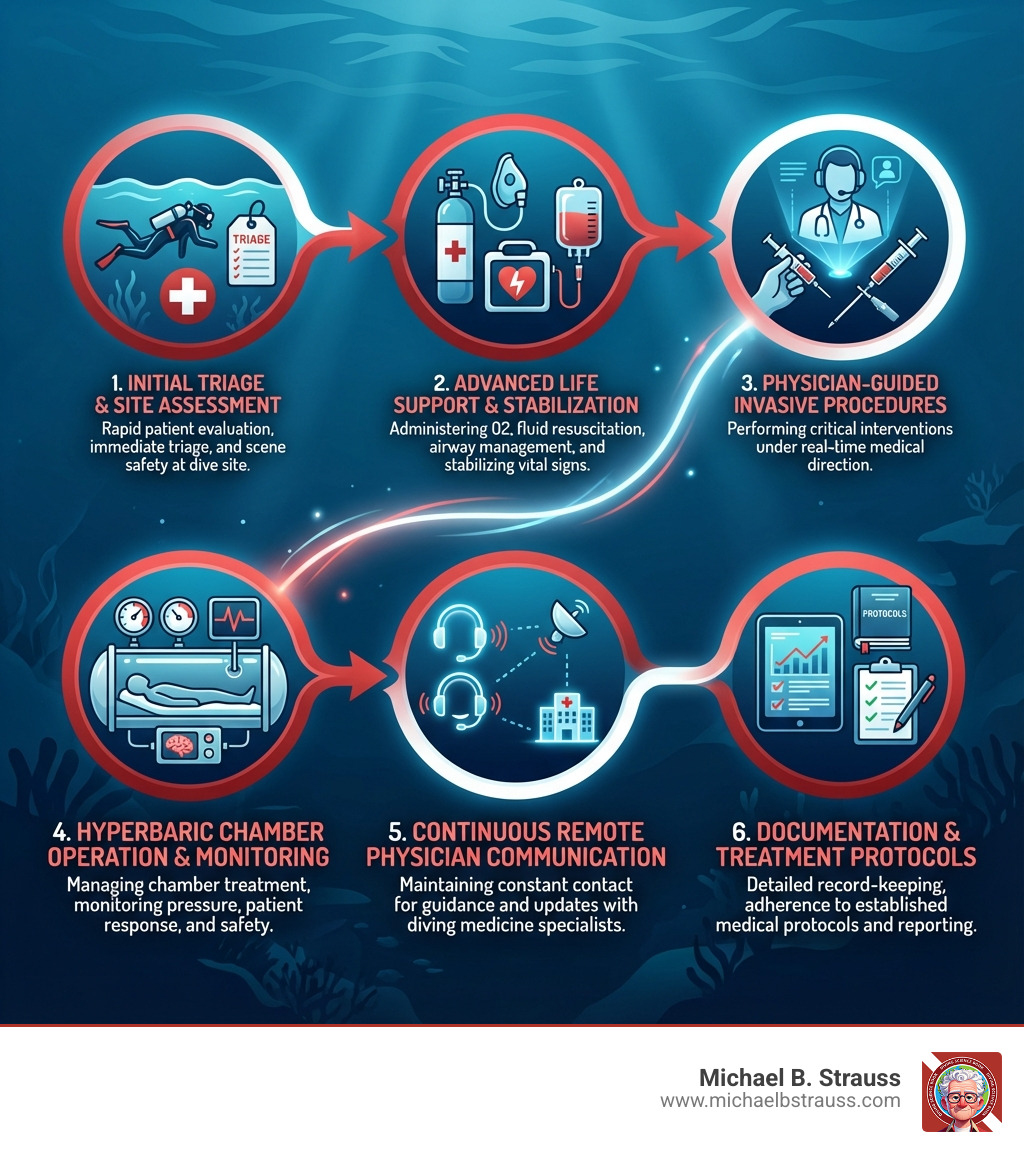
Commercial, professional, and scientific divers often work in medical and geographic isolation, where immediate evacuation is not an option. This is where a Diver Medic Technician (DMT) becomes essential. A DMT acts as the "eyes, hands, and ears" of a remote diving medicine physician, performing invasive procedures and managing hyperbaric recompression chambers on-site. Unlike standard EMTs who stabilize for transport, DMTs are trained to render definitive care under a physician's guidance.
The demand for DMTs is growing, with many US and international dive operations requiring at least one certified medic on every team. For commercial divers, EMTs, or medical professionals interested in diving medicine, a DMT certification is a significant career advancement.
Diving medical technician course helpful reading:
- scuba diving medical conditions
- scuba diving and medications
- which gas law best explains diving medical problems
The Ultimate Guide to the Diving Medical Technician Course
Becoming a Diver Medical Technician (DMT) is a significant career step, making you a frontline medical expert capable of handling complex emergencies in remote diving environments. This specialized role demands a unique blend of medical knowledge, practical skills, and an understanding of hyperbaric medicine.
Prerequisites, Costs, and Enrollment
Before enrolling in a diving medical technician course, candidates must meet several key requirements that provide a solid base for advanced training.

Essential Prerequisites for DMT Training:
- Medical Certification: A current Emergency Medical Technician (EMT) certification or Paramedic license is the most common prerequisite. Some programs may accept a Medical Person in Charge (MPIC) certificate, but NBDHMT recognition often requires an EMT background.
- Diving Qualification: For courses focused on commercial diving, a qualification such as a DCBC or IMCA Unrestricted Surface Supplied Diver is typically required.
- Medical Fitness Certificate: A current medical certificate for 'Fitness to Work in a Pressurized Setting,' signed by a physician, is mandatory.
- Basic Life Support (BLS): A current BLS certification from an approved provider with an in-person component is required. Online-only courses are not accepted.
Course Duration and Fees:
A diving medical technician course involves a significant time and financial commitment.
- Full Certification: These intensive programs typically last 10 days (48-60 hours). Many use a blended format with online theory followed by a 5-day practical session.
- Renewal Courses: To maintain the two-year certification, a shorter renewal course of about 5 days (30 hours) is required.
Course fees vary by provider but generally cover tuition, textbooks, and a diagnostic kit. It is advisable to check with individual training providers for current fee structures. For detailed guidance on certification, consult The National Board of Diving and Hyperbaric Medical Technology (NBDHMT) Resource Manual.
What to Expect from a Diving Medical Technician Course Curriculum
A diving medical technician course is an immersive program that equips you with advanced medical skills for the hyperbaric environment. It goes far beyond standard first aid.
The Blended Learning Approach:
Most DMT programs use a blended format combining online theory with intensive, hands-on practical training.
- Online Modules: Pre-course e-learning covers dive physiology and foundational medical concepts, allowing you to learn at your own pace.
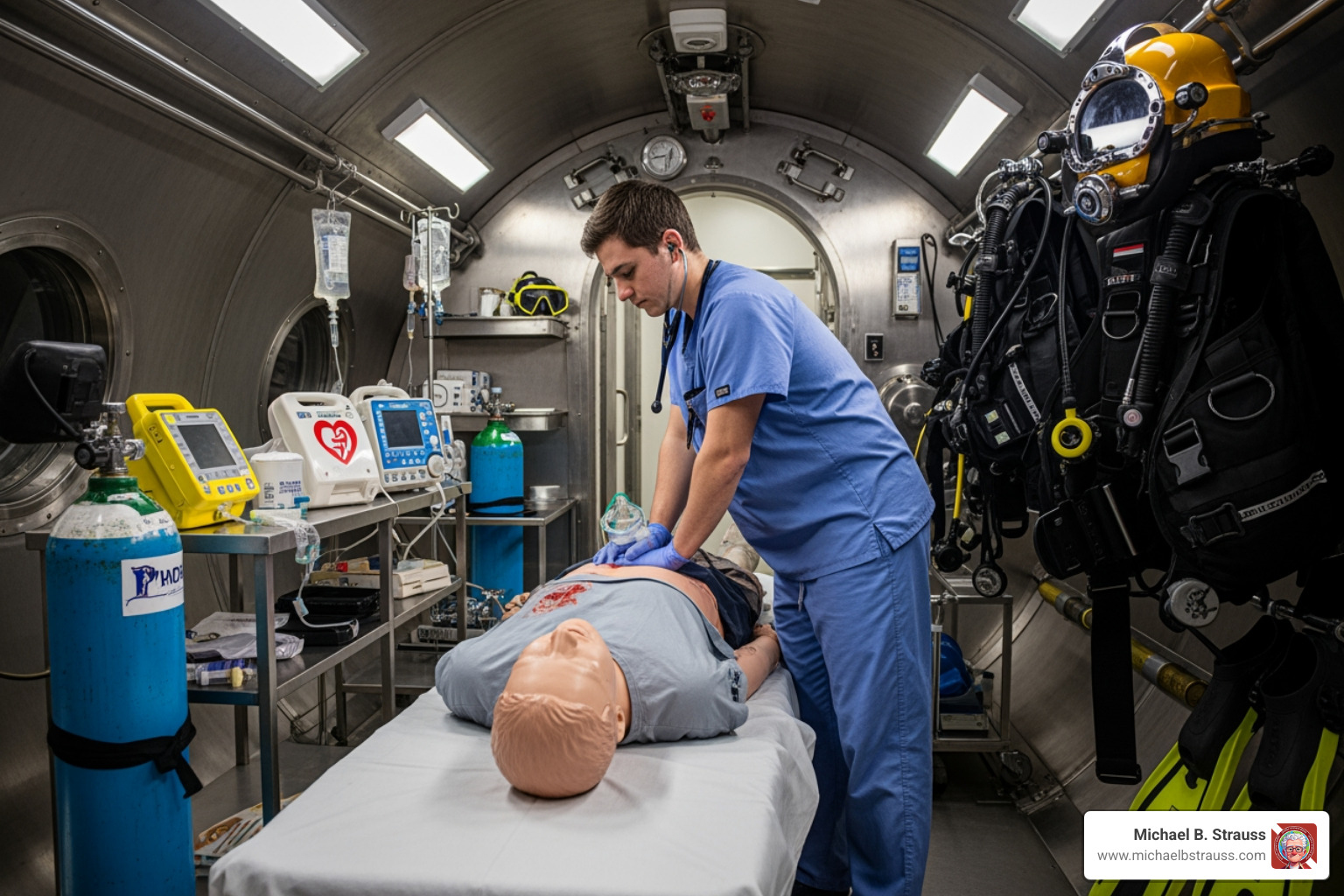
- Hands-on Practical Skills: The in-person component (5-10 days) is scenario-based, using mannequins, simulators, and hyperbaric chambers to prepare you for real-world emergencies.
Core Curriculum and Skill Development:
The curriculum for a diving medical technician course is extensive. You'll gain proficiency in:
- Medical Assessments: Performing thorough patient evaluations, with a focus on neurological exams to identify signs of decompression sickness or arterial gas embolism.
- Advanced Airway Management: Securing a patient's airway using advanced techniques.
- Invasive Procedures: Under the remote guidance of a diving physician, you'll learn to perform procedures like suturing, IV therapy, urinary catheterization, and chest decompression (needle thoracentesis).
- Hyperbaric Chamber Operations: A key component is learning to operate recompression chambers, understand treatment tables, and monitor patients under pressure.
- Managing Diving Injuries: You'll receive in-depth training on recognizing and treating specific diving-related conditions, including:
- Decompression Sickness (DCS): Learn more about Decompression Science and Why and at What Sites Decompression Sickness Can Occur.
- Barotrauma and Arterial Gas Embolism (AGE): Injuries caused by pressure changes that often require immediate recompression.
- Marine Life Injuries and Environmental Hazards: Treating stings and bites, as well as managing conditions like hypothermia and oxygen toxicity.
The goal is to train you as a first-line responder capable of providing immediate, accurate care until a diving physician can offer remote guidance or advanced help arrives.
Certification Bodies and Global Recognition
Upon completing your diving medical technician course, your certification will be recognized by key international organizations, which is vital for your career path.
Key Certification Organizations:
- National Board of Diving and Hyperbaric Medical Technology (NBDHMT): A prominent US certifying body, NBDHMT-approved courses prepare students for a board certification exam and ensure high training standards.
- International Marine Contractors Association (IMCA): IMCA certification is the global standard in the commercial diving industry, signifying compliance with rigorous international guidelines.
- Diver Certification Board of Canada (DCBC): DCBC certification is the standard for those working in or for Canadian-affiliated companies.
While all are highly respected, the best certification depends on your career goals and where you plan to work. IMCA is often preferred for international offshore work, NBDHMT is highly regarded in the US and abroad, and DCBC is essential for Canadian operations. Many courses offer training that meets the standards of multiple organizations, leading to dual recognition.
How a DMT Differs from an EMT or Diving Physician
The roles of a Diver Medical Technician (DMT), an Emergency Medical Technician (EMT), and a Diving Physician are distinct in their training, scope, and environment. The table below breaks down the key differences:
| Feature | Diver Medical Technician (DMT) | Standard EMT/Paramedic | Diving Physician |
|---|---|---|---|
| Primary Role | On-scene advanced medical support for divers; acts as the "eyes and hands" of a remote physician. | Immediate pre-hospital care; stabilization and transport to a hospital. | Medical oversight, diagnosis, and treatment planning for diving illnesses; often remote. |
| Environment | Remote, isolated dive sites (offshore rigs, research vessels); hyperbaric chambers. | Typically land-based; ambulances, emergency rooms. | Clinic, hospital, or remote consultation. |
| Scope of Practice | Performs invasive procedures and manages chamber operations under physician orders to provide definitive care. | Provides basic or advanced life support for stabilization and transport. | Full medical authority; specializes in diving and hyperbaric medicine. |
| Training Focus | Dive physiology, hyperbaric medicine, specific diving injuries (DCS, barotrauma), chamber operations. | General trauma, medical emergencies, CPR, patient assessment, transport logistics. | Advanced dive medicine, hyperbaric physiology, complex diagnostics, medical fitness for diving. |
| Key Distinction | Trained to render definitive care in a remote setting, not just stabilize for transport. | Focused on stabilization and rapid transport to definitive medical care. | Provides the ultimate medical authority and treatment plans for the DMT to execute. |
In short, an EMT's goal is to get a patient to the hospital. A DMT is trained to be the hospital in a remote diving environment, administering physician-ordered interventions that can be lifesaving when definitive care is hours away.
Career Paths and Recertification After Your Diving Medical Technician Course
DMT certification opens up specialized career opportunities and requires a commitment to ongoing professional development.
Career Opportunities and Demand:
Certified DMTs are in high demand and are often a regulatory requirement on dive teams. A diving medical technician course is an excellent investment for career advancement. Common career paths include:
- Commercial Diving: Working on offshore rigs, construction, and salvage operations.
- Scientific Diving: Supporting research vessels and marine science facilities.
- Offshore Operations: Providing medical support on oil and gas platforms and production vessels.
- Onshore Hyperbaric Facilities: Assisting in hyperbaric treatment centers.
- Military Diving: Supporting specialized military diving operations.
Recertification Requirements:
DMT certification is typically valid for two years. To maintain proficiency and stay current, recertification is required. The process generally involves:
- Continuing Education: Accumulating 24 hours of additional training, with a portion dedicated to diving medicine and the rest in general emergency medicine.
- Clinical Observation: Completing a minimum of 24 hours of ambulance or emergency room observation time.
- Maintaining EMT Status: Holding a current, underlying EMT certification.
- Recertification Fee: Paying an administrative fee.
These requirements ensure that DMTs remain ready to respond effectively to any diving medical emergency.
Taking the Next Step in Your Diving Career
Becoming a Diver Medical Technician is a challenging and rewarding step that positions you as a critical team member responsible for diver safety in demanding environments. A diving medical technician course advances your career and deepens your understanding of diving physiology and emergency medicine, making you an indispensable asset.
This commitment to knowledge and preparedness is at the core of safe diving. Dr. Michael B. Strauss, a renowned expert in diving safety, has dedicated his career to advancing the foundational knowledge that underpins safe practices. His expertise, shared through comprehensive books and resources, aligns with the DMT's focus on diver well-being.
The skills you acquire as a DMT are truly lifesaving, often making the difference in a remote emergency. To further your expertise and master the principles of diving medicine, get your copy of Diving Science Revisited today. Your journey to becoming a certified DMT is a testament to your dedication to safety in the underwater world.
DISCLAIMER: Articles are for "EDUCATIONAL PURPOSES ONLY", not to be considered advice or recommendations.


