Read story

The Unseen World: An Introduction to Cave Diving's Allure and Peril
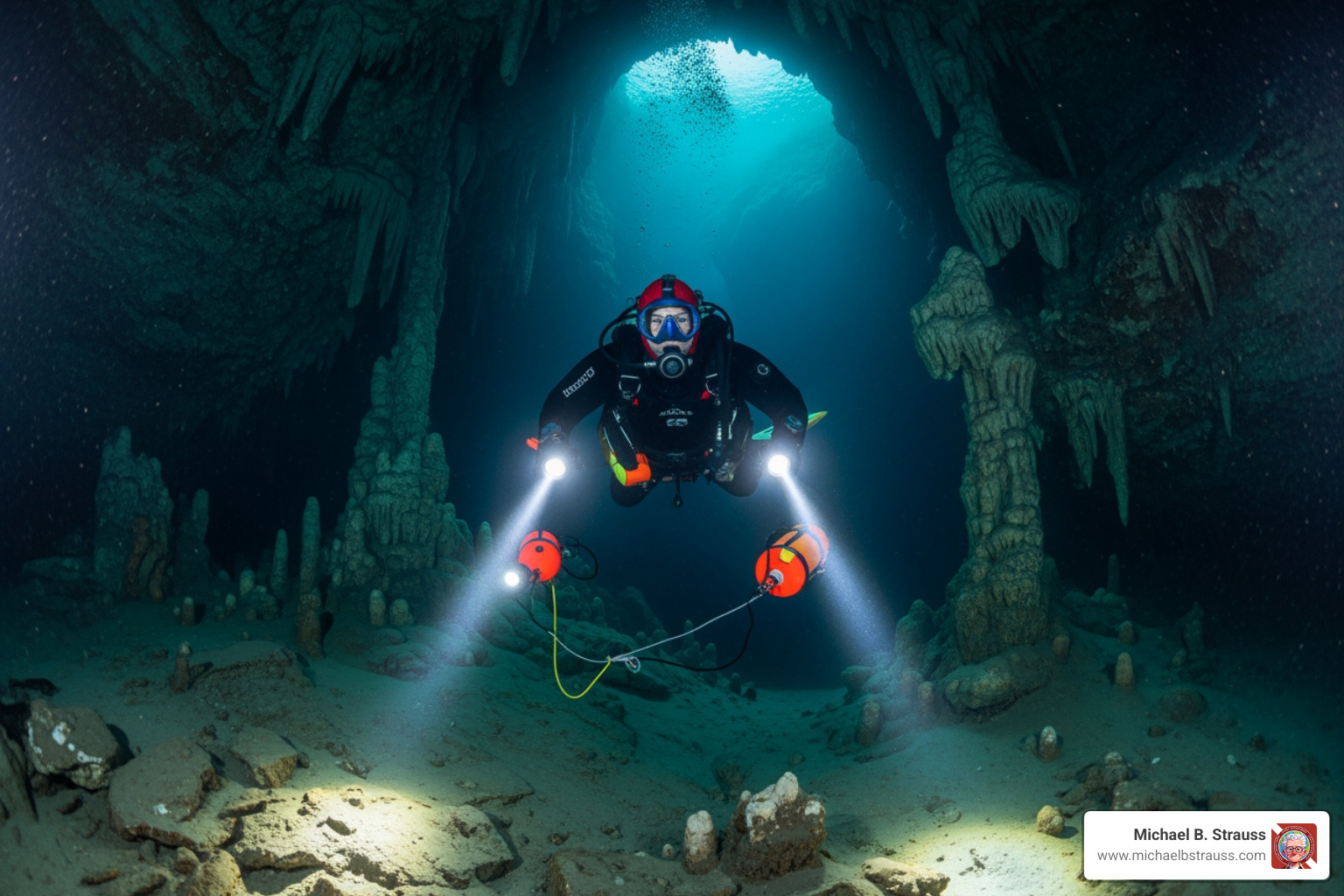
cave diver underwater in cave - cave diving dangers

Cave diving dangers represent some of the most serious risks in underwater exploration. Unlike open-water diving, cave diving places divers in an overhead environment where a direct ascent to the surface is impossible. This single factor introduces a host of potential perils, including getting lost, running out of air, equipment failure, and environmental hazards like silt-outs or tight restrictions.

The statistics are sobering: more than 300 divers have died in caves, many of whom were experienced open-water instructors. A significant number of these tragedies occurred in the cavern zone—within sight of the exit—where divers lost visibility and could not find their way out.

It's crucial to distinguish cave diving from cavern diving. Cavern diving stays within the "light zone" where the exit is visible. Cave diving ventures beyond this into total darkness, demanding specialized training, equipment, and procedures. While early accidents predominantly involved untrained divers, recent data shows a rise in fatalities among trained divers, highlighting that even with certification, there is no room for complacency.

Understanding these dangers is the first step toward managing them. Cave diving can be conducted safely, but only with proper training, meticulous planning, and unwavering respect for the environment.
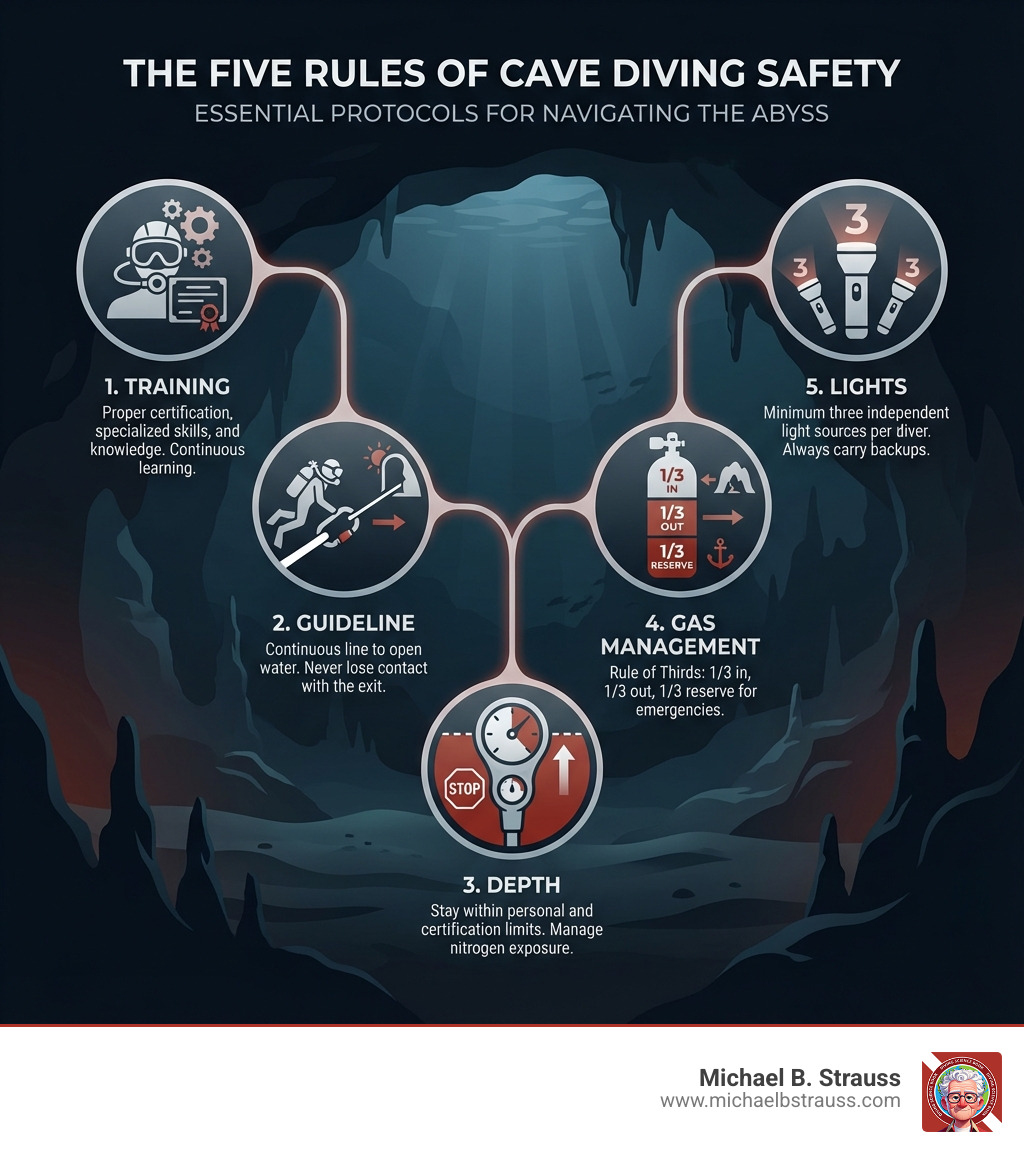
infographic showing the five rules of cave diving safety: Training (proper certification and skills), Guideline (continuous line to open water), Depth (diving within gas and experience limits), Gas Management (Rule of Thirds - one third in, one third out, one third reserve), and Lights (minimum three independent light sources per diver) - cave diving dangers infographic

Relevant articles related to cave diving dangers:

A Deep Dive into the Primary Cave Diving Dangers

To manage cave diving dangers, we must first understand them. Legendary explorer Sheck Exley provided the foundation for this in his 1979 handbook, Basic Cave Diving: A Blueprint for Survival. His analysis of fatalities established the "five rules of survival" that remain the bedrock of safe cave diving: Training, Guideline, Depth, Gas, and Lights.

Cave diving is a discipline of technical diving, not an extension of recreational diving. It demands a unique mindset, specialized gear, and training that far exceeds standard open-water courses. The "Grim Reaper" signs at cave entrances are not for dramatic effect; they are stark warnings that unpreparedness can be fatal. A systematic analysis of fatalities consistently reveals that poor planning, inadequate training, and failure to follow protocols are the primary causes of accidents.
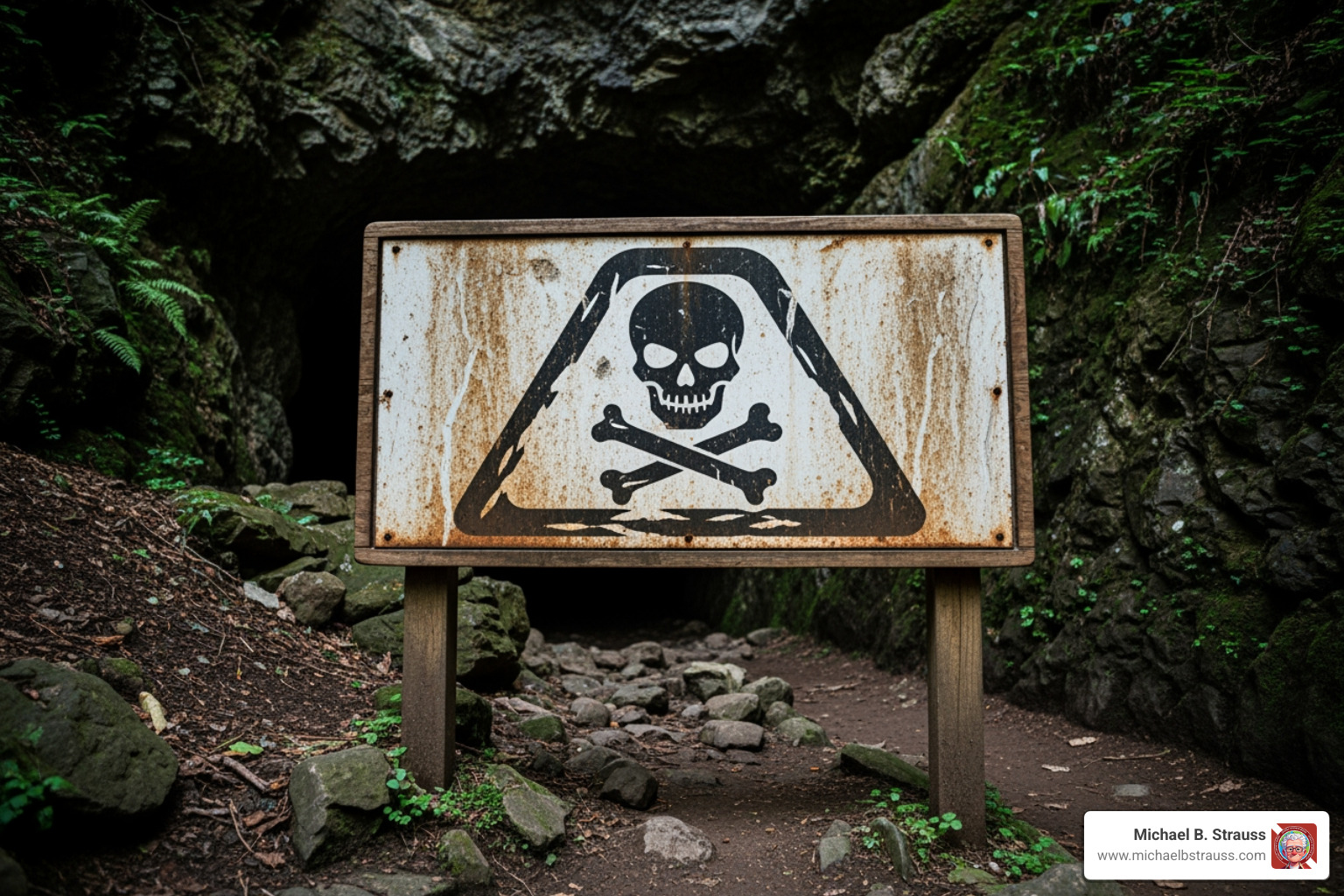
Grim Reaper warning sign at cave entrance - cave diving dangers

Danger #1: Diving Beyond Your Training

One of the most critical cave diving dangers is the misconception that open-water experience is sufficient for an overhead environment. Many fatalities have been open-water instructors who lacked the specialized skills for a world without direct access to the surface. The skills gap is immense; cave diving requires mastery of precise buoyancy, specialized propulsion techniques to avoid stirring up silt, and proficiency in laying and following guidelines in total darkness.

Proper training follows a progressive path, typically from Cavern Diver (in the light zone) to Intro-to-Cave and finally Full-Cave Diver certification. Each level builds crucial skills in navigation, gas management, and emergency protocols for increasingly complex dives. Diving without this specific training is a leading cause of preventable tragedies, a fact reinforced by every Review of American cave diving fatalities. Even with certification, pushing beyond one's current capabilities or becoming complacent can be just as deadly.

Danger #2: Disorientation and Getting Lost

In the dark, featureless passages of a cave, disorientation is a primary contributor to cave diving dangers. The continuous guideline is a diver's lifeline to the surface, and failure to maintain contact with it is a direct cause of many fatalities.
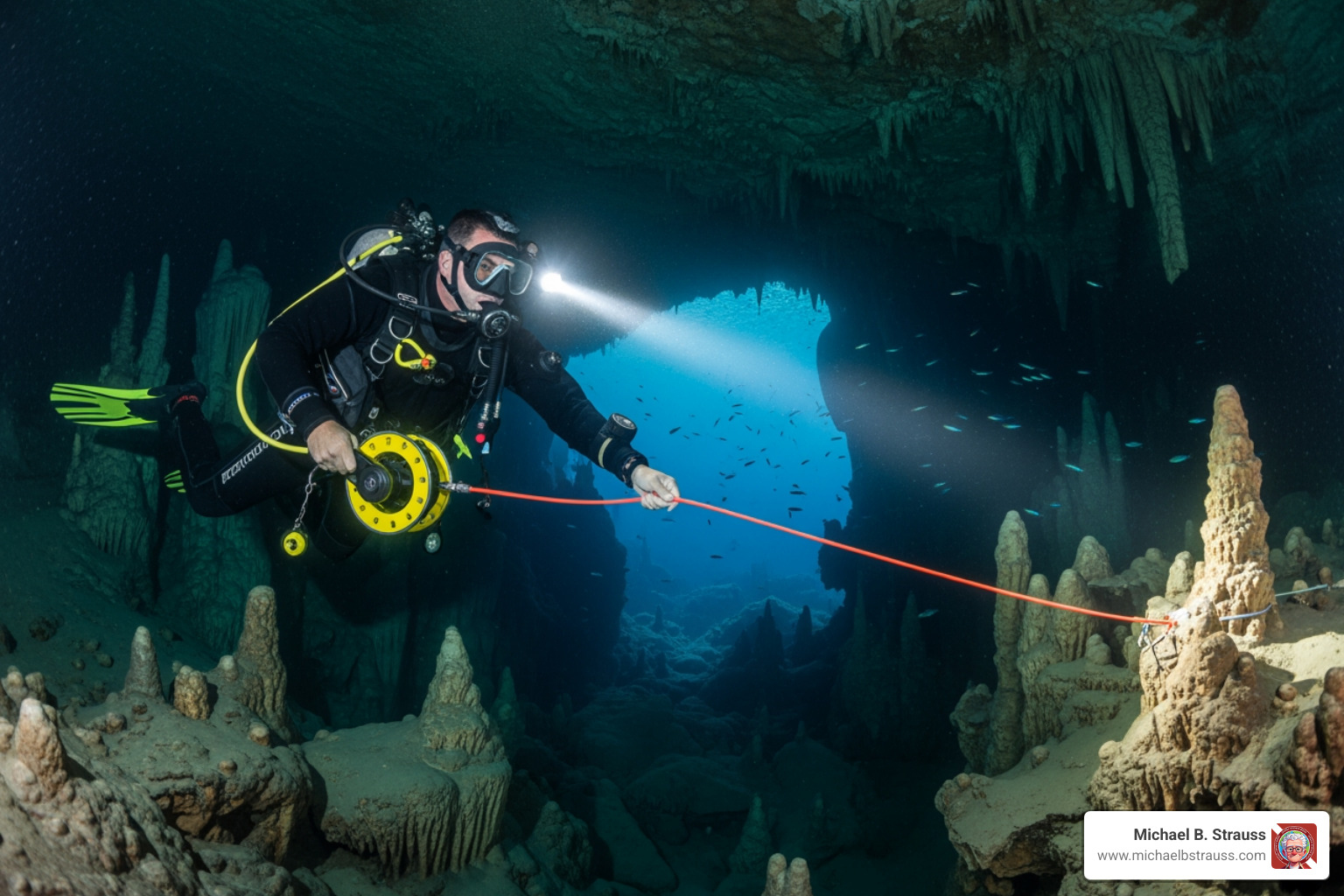
diver laying guideline with reel in cave - cave diving dangers

This risk is amplified by "silt-outs," where a careless fin kick can instantly reduce visibility to zero. In these blackout conditions, the guideline is the only way out. Losing it can lead to disorientation, panic, and exhausting one's air supply while searching for an exit. Complex passages and confusing "line messes" from previous dives further complicate navigation.

To combat this, divers use essential navigation tools:

  • Primary reel and safety spool: To lay and repair guidelines.
  • Directional markers (arrows): To point toward the exit.
  • Non-directional markers (cookies): To mark junctions or personal lines.

Proficiency with these tools, practiced until it's second nature, is non-negotiable for safe navigation.

Danger #3: Mismanaging Your Most Precious Resource - Air

Mismanaging breathing gas is one of the most unforgiving cave diving dangers. The "Rule of Thirds" is the non-negotiable standard for gas management in overhead environments:

  • One-third of the gas supply for penetration (inward journey).
  • One-third for the exit (outward journey).
  • One-third held as an emergency reserve.

This rule ensures a diver has enough gas to exit safely, even if they must share air with a buddy experiencing a complete gas loss. Violating this rule by pushing too far into a cave leaves no margin for error. Stress from an emergency like a silt-out or disorientation dramatically increases breathing rate, depleting a diver's remaining gas supply with terrifying speed. Running out of air, often after getting lost, is a common cause of death in caves.

Effective gas planning also accounts for depth, workload, and potential emergencies. Mastering gas management is a foundational skill that prioritizes discipline over impulse. To understand more about the physical aspects of diving, we encourage you to learn about the science of decompression.

Danger #4: Environmental Traps and Physical Hazards

The cave itself presents formidable cave diving dangers. Fine silt can cause instant zero-visibility "silt-outs." Strong currents can pull divers deeper into a system or make an exit physically exhausting. Physical obstructions range from narrow "restrictions" that require removing gear to pass, to unstable formations and debris.

A deceptive trap is the "false chimney," an upward passage that appears to lead to the surface but is actually a dead end, as detailed in this explanation of a \"false chimney\". A disoriented diver might waste precious air trying to ascend into it.

Depth amplifies every risk. Increased pressure accelerates gas consumption and can cause nitrogen narcosis, which impairs judgment and coordination. While recreational divers are limited to 40 meters (130 feet), cave divers often go deeper, requiring special gas mixtures like Trimix (helium, nitrogen, oxygen) to counteract narcosis and detailed decompression plans to surface safely. Diving to excessive depths without proper training and gas is a leading cause of fatalities.

Danger #5: Equipment Failure Without Redundancy

In an overhead environment, equipment failure can be catastrophic. Redundancy is a core philosophy to counter these cave diving dangers. Every critical piece of gear must have a backup. A primary light failure, for example, would plunge a diver into absolute darkness, likely causing panic. Therefore, cave divers carry a primary light and at least two independent backup lights.

This principle extends to all life-support systems. Key redundant gear includes:

  • Three light sources (one primary, two backups).
  • Redundant breathing systems (independent doubles or a dual-outlet manifold on a single tank).
  • A backup mask.
  • Backup depth and pressure gauges.
  • At least two cutting devices.

Even with advanced equipment like rebreathers, divers must have the skills and bailout gas to return safely on open-circuit systems. Investing in high-quality equipment and maintaining it carefully is a direct investment in survival.

Danger #6: The Psychological Toll and Unique Cave Diving Dangers

The mind is a critical factor when facing cave diving dangers. The environment itself—total darkness, silence, and confinement—can cause sensory deprivation and anxiety. This is compounded by high "task loading," as divers must simultaneously steer, monitor gas, and maintain buoyancy. An emergency can quickly overload a diver's cognitive capacity.

Panic is the ultimate enemy. A panicked diver loses the ability to think rationally, often leading to fatal mistakes like losing the guideline or rapidly depleting their air. Many victims are found with air still in their tanks, having been unable to access it due to overwhelming fear.

Mental preparedness is therefore paramount. Training should include stress inoculation, where emergency procedures are practiced until they become automatic. A calm, methodical mindset is a diver's most important tool. Understanding your own limits and how your body responds to stress, as detailed when we understand the body's response to diving, is key to managing these psychological challenges.

Conclusion: Mitigating Risk Through Knowledge and Preparation

The world of cave diving is filled with cave diving dangers, from getting lost and running out of air to equipment failure and psychological stress. The risks are significant, but they are not impossible. As we've seen, cave diving is not a death wish; it is an activity where risk is managed through rigorous training, meticulous planning, and an unwavering respect for the overhead environment.

Safe exploration is possible for those who commit to the discipline. Dr. Michael B. Strauss, a renowned expert in diving safety, consistently emphasizes the critical role of knowledge in his comprehensive diving books. These resources are invaluable for any diver seeking to master the principles of safety. By embracing continuous learning and a cautious mindset, we can steer the abyss with confidence.

For those eager to dig deeper into the science that underpins safe diving practices, we invite you to explore more about the science of safe diving.

To master the principles of safe diving, get your copy of "Diving Science, Revisited" today. Buy the book here.

DISCLAIMER: Articles are for "EDUCATIONAL PURPOSES ONLY", not to be considered advice or recommendations.

Download Full PDF
Tags:

The Unseen World: An Introduction to Cave Diving's Allure and Peril

cave diver underwater in cave - cave diving dangers

Cave diving dangers represent some of the most serious risks in underwater exploration. Unlike open-water diving, cave diving places divers in an overhead environment where a direct ascent to the surface is impossible. This single factor introduces a host of potential perils, including getting lost, running out of air, equipment failure, and environmental hazards like silt-outs or tight restrictions.

The statistics are sobering: more than 300 divers have died in caves, many of whom were experienced open-water instructors. A significant number of these tragedies occurred in the cavern zone—within sight of the exit—where divers lost visibility and could not find their way out.

It's crucial to distinguish cave diving from cavern diving. Cavern diving stays within the "light zone" where the exit is visible. Cave diving ventures beyond this into total darkness, demanding specialized training, equipment, and procedures. While early accidents predominantly involved untrained divers, recent data shows a rise in fatalities among trained divers, highlighting that even with certification, there is no room for complacency.

Understanding these dangers is the first step toward managing them. Cave diving can be conducted safely, but only with proper training, meticulous planning, and unwavering respect for the environment.

infographic showing the five rules of cave diving safety: Training (proper certification and skills), Guideline (continuous line to open water), Depth (diving within gas and experience limits), Gas Management (Rule of Thirds - one third in, one third out, one third reserve), and Lights (minimum three independent light sources per diver) - cave diving dangers infographic

Relevant articles related to cave diving dangers:

A Deep Dive into the Primary Cave Diving Dangers

To manage cave diving dangers, we must first understand them. Legendary explorer Sheck Exley provided the foundation for this in his 1979 handbook, Basic Cave Diving: A Blueprint for Survival. His analysis of fatalities established the "five rules of survival" that remain the bedrock of safe cave diving: Training, Guideline, Depth, Gas, and Lights.

Cave diving is a discipline of technical diving, not an extension of recreational diving. It demands a unique mindset, specialized gear, and training that far exceeds standard open-water courses. The "Grim Reaper" signs at cave entrances are not for dramatic effect; they are stark warnings that unpreparedness can be fatal. A systematic analysis of fatalities consistently reveals that poor planning, inadequate training, and failure to follow protocols are the primary causes of accidents.

Grim Reaper warning sign at cave entrance - cave diving dangers

Danger #1: Diving Beyond Your Training

One of the most critical cave diving dangers is the misconception that open-water experience is sufficient for an overhead environment. Many fatalities have been open-water instructors who lacked the specialized skills for a world without direct access to the surface. The skills gap is immense; cave diving requires mastery of precise buoyancy, specialized propulsion techniques to avoid stirring up silt, and proficiency in laying and following guidelines in total darkness.

Proper training follows a progressive path, typically from Cavern Diver (in the light zone) to Intro-to-Cave and finally Full-Cave Diver certification. Each level builds crucial skills in navigation, gas management, and emergency protocols for increasingly complex dives. Diving without this specific training is a leading cause of preventable tragedies, a fact reinforced by every Review of American cave diving fatalities. Even with certification, pushing beyond one's current capabilities or becoming complacent can be just as deadly.

Danger #2: Disorientation and Getting Lost

In the dark, featureless passages of a cave, disorientation is a primary contributor to cave diving dangers. The continuous guideline is a diver's lifeline to the surface, and failure to maintain contact with it is a direct cause of many fatalities.

diver laying guideline with reel in cave - cave diving dangers

This risk is amplified by "silt-outs," where a careless fin kick can instantly reduce visibility to zero. In these blackout conditions, the guideline is the only way out. Losing it can lead to disorientation, panic, and exhausting one's air supply while searching for an exit. Complex passages and confusing "line messes" from previous dives further complicate navigation.

To combat this, divers use essential navigation tools:

  • Primary reel and safety spool: To lay and repair guidelines.
  • Directional markers (arrows): To point toward the exit.
  • Non-directional markers (cookies): To mark junctions or personal lines.

Proficiency with these tools, practiced until it's second nature, is non-negotiable for safe navigation.

Danger #3: Mismanaging Your Most Precious Resource - Air

Mismanaging breathing gas is one of the most unforgiving cave diving dangers. The "Rule of Thirds" is the non-negotiable standard for gas management in overhead environments:

  • One-third of the gas supply for penetration (inward journey).
  • One-third for the exit (outward journey).
  • One-third held as an emergency reserve.

This rule ensures a diver has enough gas to exit safely, even if they must share air with a buddy experiencing a complete gas loss. Violating this rule by pushing too far into a cave leaves no margin for error. Stress from an emergency like a silt-out or disorientation dramatically increases breathing rate, depleting a diver's remaining gas supply with terrifying speed. Running out of air, often after getting lost, is a common cause of death in caves.

Effective gas planning also accounts for depth, workload, and potential emergencies. Mastering gas management is a foundational skill that prioritizes discipline over impulse. To understand more about the physical aspects of diving, we encourage you to learn about the science of decompression.

Danger #4: Environmental Traps and Physical Hazards

The cave itself presents formidable cave diving dangers. Fine silt can cause instant zero-visibility "silt-outs." Strong currents can pull divers deeper into a system or make an exit physically exhausting. Physical obstructions range from narrow "restrictions" that require removing gear to pass, to unstable formations and debris.

A deceptive trap is the "false chimney," an upward passage that appears to lead to the surface but is actually a dead end, as detailed in this explanation of a \"false chimney\". A disoriented diver might waste precious air trying to ascend into it.

Depth amplifies every risk. Increased pressure accelerates gas consumption and can cause nitrogen narcosis, which impairs judgment and coordination. While recreational divers are limited to 40 meters (130 feet), cave divers often go deeper, requiring special gas mixtures like Trimix (helium, nitrogen, oxygen) to counteract narcosis and detailed decompression plans to surface safely. Diving to excessive depths without proper training and gas is a leading cause of fatalities.

Danger #5: Equipment Failure Without Redundancy

In an overhead environment, equipment failure can be catastrophic. Redundancy is a core philosophy to counter these cave diving dangers. Every critical piece of gear must have a backup. A primary light failure, for example, would plunge a diver into absolute darkness, likely causing panic. Therefore, cave divers carry a primary light and at least two independent backup lights.

This principle extends to all life-support systems. Key redundant gear includes:

  • Three light sources (one primary, two backups).
  • Redundant breathing systems (independent doubles or a dual-outlet manifold on a single tank).
  • A backup mask.
  • Backup depth and pressure gauges.
  • At least two cutting devices.

Even with advanced equipment like rebreathers, divers must have the skills and bailout gas to return safely on open-circuit systems. Investing in high-quality equipment and maintaining it carefully is a direct investment in survival.

Danger #6: The Psychological Toll and Unique Cave Diving Dangers

The mind is a critical factor when facing cave diving dangers. The environment itself—total darkness, silence, and confinement—can cause sensory deprivation and anxiety. This is compounded by high "task loading," as divers must simultaneously steer, monitor gas, and maintain buoyancy. An emergency can quickly overload a diver's cognitive capacity.

Panic is the ultimate enemy. A panicked diver loses the ability to think rationally, often leading to fatal mistakes like losing the guideline or rapidly depleting their air. Many victims are found with air still in their tanks, having been unable to access it due to overwhelming fear.

Mental preparedness is therefore paramount. Training should include stress inoculation, where emergency procedures are practiced until they become automatic. A calm, methodical mindset is a diver's most important tool. Understanding your own limits and how your body responds to stress, as detailed when we understand the body's response to diving, is key to managing these psychological challenges.

Conclusion: Mitigating Risk Through Knowledge and Preparation

The world of cave diving is filled with cave diving dangers, from getting lost and running out of air to equipment failure and psychological stress. The risks are significant, but they are not impossible. As we've seen, cave diving is not a death wish; it is an activity where risk is managed through rigorous training, meticulous planning, and an unwavering respect for the overhead environment.

Safe exploration is possible for those who commit to the discipline. Dr. Michael B. Strauss, a renowned expert in diving safety, consistently emphasizes the critical role of knowledge in his comprehensive diving books. These resources are invaluable for any diver seeking to master the principles of safety. By embracing continuous learning and a cautious mindset, we can steer the abyss with confidence.

For those eager to dig deeper into the science that underpins safe diving practices, we invite you to explore more about the science of safe diving.

To master the principles of safe diving, get your copy of "Diving Science, Revisited" today. Buy the book here.

DISCLAIMER: Articles are for "EDUCATIONAL PURPOSES ONLY", not to be considered advice or recommendations.